
A No-Nonsense Calculation Guide
If you’ve ever stood in a half-lit warehouse aisle squinting at a picking list, you already know the answer: more than you have right now. Getting the exact number — the lumen count that actually works for your space — is where most warehouse operators either overpay or under-deliver.
I’ve walked through warehouses where the lighting designer clearly just multiplied square footage by a rule-of-thumb number and called it a day. The result: 800 lux in the forklift charging station, 80 lux in the picking zone. Both wrong, in opposite directions.
Let’s fix that.
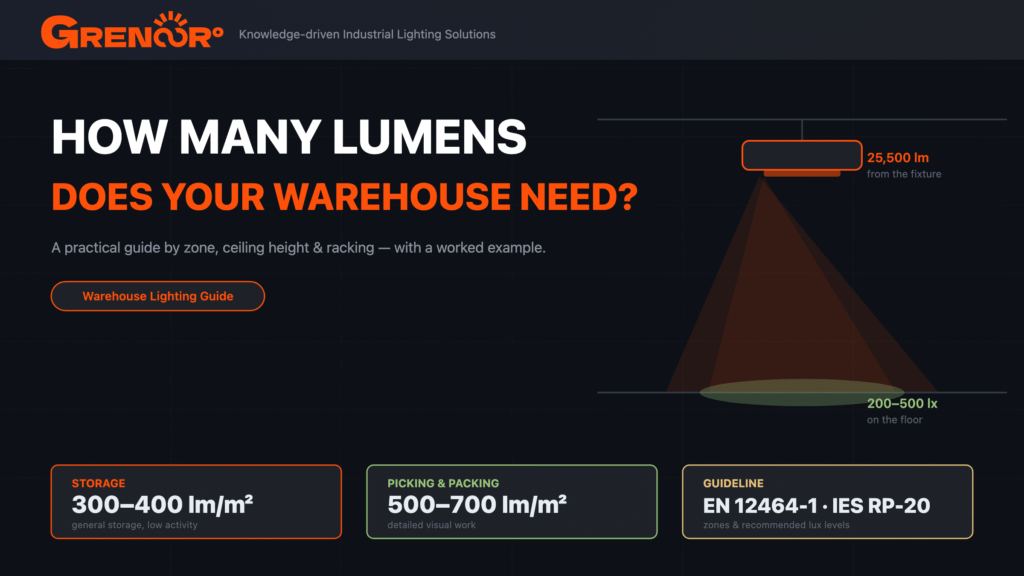
Quick answer: Most warehouses need 300–400 lumens per square meter for general storage and 500–700 lumens per square meter for detailed work areas (picking, packing, QC). But the right number depends on your ceiling height, racking, and zone. Use the table and calculation below to get a figure that fits your facility — not a generic average.
Lumens vs. Lux: Get This Straight First
Before you touch a calculator, clear up the most common confusion I see on site visits.
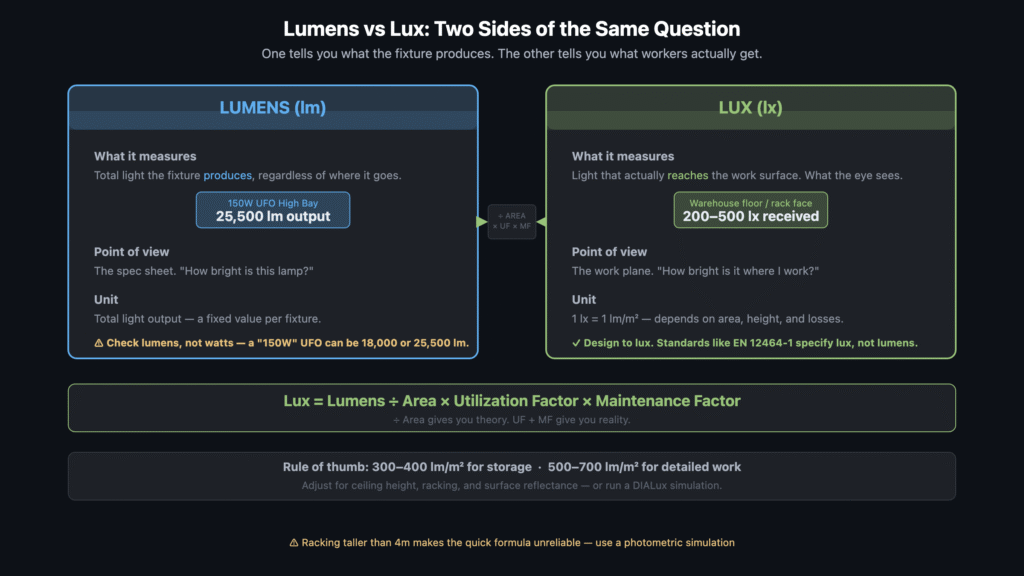
- Lumens (lm) measure how much light a fixture produces — the raw output printed on the box.
- Lux (lx) measures how much light actually lands on a surface. One lux equals one lumen per square meter.
You don’t care about lumens. You care about lux. Your workers don’t operate inside the fixture — they work on the floor, at the rack face, on the picking table. The real question isn’t “how bright is this light?” It’s “how bright is the surface where people are actually working?”
The relationship:
Lux = Lumens ÷ Area × Utilization Factor × Maintenance Factor
That last part — utilization and maintenance — is where most DIY calculations fall apart. More on that below.
What Lux Levels Do Warehouses Actually Need?
Here’s the thing: there’s no single number. A warehouse isn’t one space — it’s a collection of zones doing different jobs. The mistake I see repeatedly is treating a 50,000 sq ft facility as one uniform lighting problem.
| Warehouse Zone | Recommended Lux (EN 12464-1) | What Actually Happens |
|---|---|---|
| Bulk storage (low activity) | 100 lux | Goods sit there. People visit occasionally. Don’t over-light it. |
| Aisle / Rack access | 150 lux | Forklifts need to read rack labels from 2–3 meters away. |
| Manual picking area | 200–300 lux | Humans reading small text on labels. Under-light here and error rates climb. |
| Packing & sorting | 300–500 lux | Fine visual tasks. Barcode scanning. Quality checks. |
| Loading dock (indoor) | 150–200 lux | Transition zone. Watch for glare when doors open to daylight. |
| Office / Admin area | 500 lux | Standard office lighting rules apply. |
For North America: IES RP-20 gives similar guidance using “Class I–IV” categories. Class II (moderate activity, larger items) ≈ 100–200 lux. Class III (fine tasks) ≈ 300–500 lux.
Real example: a 3PL client of mine had 28,000 sq ft under a uniform 180 lux. We split it into three zones — bulk storage at 120 lux, picking at 280 lux, packing at 450 lux. Total fixture count went down by 12%. Worker complaints about “bad lighting” disappeared within a week. Why? The light finally went where the eyes were.
The Quick Calculation (For Most Warehouses)
Want a back-of-the-envelope starting point? Here it is:
Step 1: Measure the area in square meters (sq ft × 0.093)
Step 2: Multiply by your target lux (use the table above)
Step 3: Multiply by 1.4 (rough factor for utilization + maintenance losses)
Step 4: That’s your total required lumens
Step 5: Divide by lumens per fixture to get fixture count
Worked example — 10,000 sq ft warehouse, 8-meter ceiling, general storage:
| Step | Calculation | Result |
|---|---|---|
| Area in m² | 10,000 × 0.093 | 929 m² |
| Target lux | Storage area | 150 lux |
| Raw lumens needed | 929 × 150 | 139,350 lm |
| With losses (÷0.7 efficient) | 139,350 ÷ 0.7 | 199,071 lm |
| UFO high bay (150W, 170 lm/W) | 25,500 lm per fixture | |
| Fixtures needed | 199,071 ÷ 25,500 | ~8 fixtures |
So roughly 8 × 150W LED high bay fixtures for a 10,000 sq ft storage warehouse with 8m ceilings.
That assumes even spacing and a rectangular layout, though. Real warehouses have racking. Here’s why that matters.
Why Racking Changes Everything
Put 10-meter-high pallet racks in that same 10,000 sq ft space, and the quick calculation above becomes borderline useless.
- Shadowing — Racks block light. A fixture centered over an aisle might deliver 200 lux at floor level in an open area, but only 80 lux between two rows of 8-meter racks.
- Vertical illumination — Workers need to read labels at heights of 2, 4, 6, and 8 meters. A fixture optimized for floor lux might leave rack faces in the dark.
- Aisle width — A 3-meter aisle needs different spacing than a 4.5-meter aisle.
Run a photometric simulation (DIALux or similar) for any warehouse with racking taller than 4 meters. The quick calculation gets you a budget number. The simulation gets you a design that actually works.
The Ceiling Height Factor
Higher ceilings need more lumens — not because the space is bigger, but because light spreads and loses intensity with distance. It follows the inverse square law: double the distance, quarter the intensity.
| Mounting Height | Typical Fixture Type | Approx Lumens per m² (for 200 lux) |
|---|---|---|
| 4–6 meters | Linear high bay | 280–350 lm/m² |
| 6–10 meters | UFO high bay, 90°–120° beam | 320–420 lm/m² |
| 10–15 meters | UFO high bay, 60°–90° beam | 400–550 lm/m² |
| >15 meters | Narrow beam UFO + supplementary | 550+ lm/m² |
These are rough ranges. Actual numbers depend on beam angle, fixture spacing, and surface reflectance.
The Mistake I See Most Often
People buy “150W LED high bay lights” because that’s what their competitor used. They never check the lumens. Here’s the reality:
- A cheap 150W UFO might output 18,000 lumens (120 lm/W)
- A quality 150W UFO might output 25,500 lumens (170 lm/W)
- That’s a 42% difference in actual light output from the same wattage
Check lumens, not watts. Ask for the IES file. If a supplier can’t provide one for their fixture, walk away — they don’t know their own product’s performance.
FAQ
How many lumens per square foot does a warehouse need?
For general storage, aim for roughly 28–37 lumens per square foot (300–400 lm/m²). Picking and packing areas need closer to 46–65 lumens per square foot (500–700 lm/m²).
Is 5000K or 6500K better for warehouse lighting?
5000K is the industry default — it renders colors accurately without the harsh blue tint of 6500K, and it’s easier on the eyes over a full shift. 6500K can feel clinical in enclosed spaces.
Do I need a photometric study, or is the quick calculation enough?
The quick calculation is fine for a budget estimate on open-plan storage under 4-meter racking. Anything taller, or with dense racking, needs a DIALux simulation — shadowing changes the math too much to eyeball it.
How much does over-lighting a warehouse actually cost?
More than people think. Every lux above spec is wasted electricity and wasted fixture capacity. On a 200-fixture facility, over-specifying by even one tier (say, 300 lux instead of 200 lux for aisles) can add 20–30% to both the fixture count and the annual power bill.
Bottom Line
For most warehouses, aim for 300–400 lumens per square meter for general storage, and 500–700 lumens per square meter for areas with detailed work. That’s the starting point, though — the real answer depends on ceiling height, rack layout, aisle width, and surface colors.
Dealing with a warehouse taller than 8 meters, or with high-density racking? Skip the calculator and get a photometric simulation. The cost of getting it wrong — in worker errors, safety incidents, and wasted electricity — is far higher than the cost of getting it right the first time.
Need help calculating the right lighting for your warehouse? Contact us for a free lumen requirement estimate based on your specific layout.