
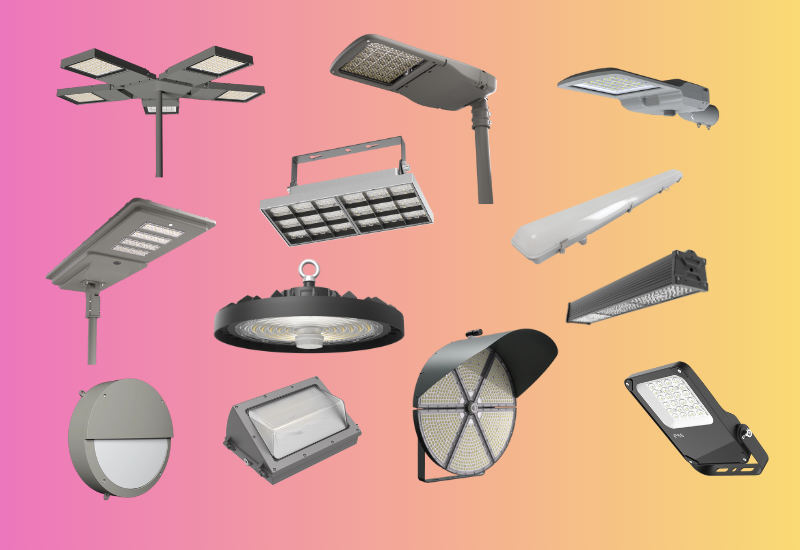
The differences between traditional & led lighting
To understand the future, you must first see the past. Let’s compare the 3 main lighting technologies across critical performance metrics.
| Feature | Incandescent | Fluorescent | LED |
| Start-up time | 5-15mins warm-up | 30s to full brightness | Instant on |
| Efficiency | 50-80lm/w | 60-100lm/w | 100-200lm/w |
| Lifespan | <15,000hours | <30,000hours | 50,000-100,000hours |
| Controls | Non-dimming | Limited dimming range | Fully dimmable with 0-10V, DALI, PWM, Triac, and supports sensor functions and related smart control |
| Maintenance | High defective rate with poor lumen maintenance | Middle defective rate with low lumen maintenance | Ultra-low defective rate with super long lifespan |
| Environmental | Contains mercury | Contains mercury | No hazardous materials and RoHS, Reach certified |
The Core Advantages of LED Lighting
The true advantages of LED lighting are reflected in your electricity bills and maintenance operations, truly translating technical specifications into business value.
The Unbeatable Financial ROI
Stop looking at the sticker price of a single lighting fixture. The decisive metric is Total Cost of Ownership (TCO) over 10 years.
Energy Savings: A 300W LED Highbay often outperforms a 1000W metal halide. For a single fixture running 6,000 hours annually, that’s 4,200 kWh saved per year. At commercial rates, that’s saved by per fixture, per year. For a warehouse with 1000 fixtures, the annual savings on electric bills can even fund the entire project in the short term.
Maintenance Elimination: Consider the true cost of a lamp change in a 30ft high warehouse: lift rental, two technicians for safety. A single change can cost times more than the cost of the lights themselves. With LEDs lasting 5-10 times longer than traditional lights, you eliminate dozens of these events, protecting both your budget and staff from hazardous aerial work.
Superior performance and user experience
LEDs provide better lighting performance and more options for smart controls.
Better lighting performance: LEDs reach full brightness immediately, with an excellent Color Rendering Index (CRI) that makes colors look true and vibrant, crucial for retail stores, workshops, and homes.
Advanced Control: LEDs are compatible with smart systems. You can dim seamlessly from 0% to 100%, adjust color temperature (from warm white to cool white), and integrate with motion sensors or scheduling for ultimate efficiency and energy-savings.
Durability and safety
Robust Construction: Their solid-state design makes LED highly resistant to vibration and impact—a key advantage for industrial lighting, warehouses, and outdoor fixtures exposed to the elements.
Cooler Operation & Safety: LEDs emit very little heat (infrared radiation) compared to incandescents. This reduces fire risk, lowers air conditioning loads, and makes them safer to touch and use in enclosed spaces.
Sustainability
Today’s ESG and corporate carbon goals make LED retrofits a strategic move.
Direct Carbon Reduction: The energy savings translate directly into lower carbon emissions. A 100-fixture project can easily reduce a facility’s carbon footprint by 200+ metric tons of CO2 annually.
Sustainable Design: Leading manufacturers now design for circular economy principles: tool-free access for driver replacement, modular optics, and materials that are easily segregated for recycling at end-of-life.
Long-Term Viability: As global regulations phase out inefficient lighting, LED is the established, future-proof technology. Investing in it now means avoiding another costly retrofit later.